Gemini_Generated_Image
Building a Leader: Impact of a Fly’s Drag
We can’t simulate the entire process without thinking about drag.
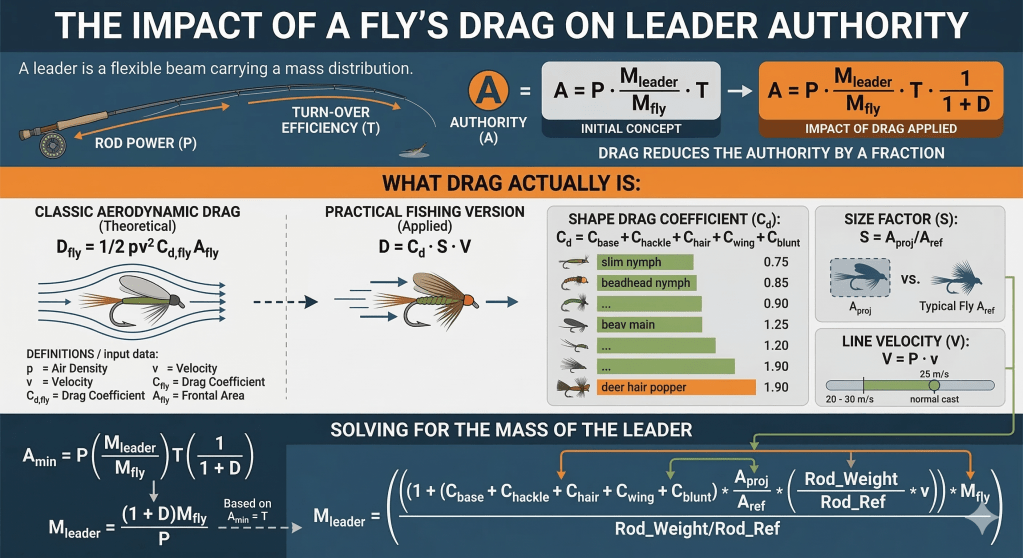
A leader is a flexible beam carrying a mass distribution:
A = P (M_leader / M_fly) T
But we still haven’t defined the drag of the fly. First, with the impact of drag being applied, it reduces the authority by a fraction:
A = P (M_leader / M_fly) T (1/1+D)
What drag actually is:
D_fly = 1/2 p v^2 C_d,fly A_fly
Where:
p = air density
v = velocity
C_d, fly = drag coefficient
A_fly = frontal area
But a practical fishing version, without aerodynamic drag force, is simply:
D = C_d * S * V
Where:
C_d = shape drag coefficient
C_d=C_base+C_hackle+C_hair+C_wing+C_blunt
Fly type (C_d)
slim nymph 0.75
beadhead nymph 0.85
wet fly 0.95
sparse streamer 1.00
woolly bugger 1.20
standard dry 1.25
parachute dry 1.40
hopper 1.55
bass bug 1.70
deer hair popper 1.90
S = projected area or “Size Factor”
So, normalized to stay dimensionless (which is what allows the model to stay coherent):
S = A_proj / A_ref
Where:
A_proj ≈ (4/π) * w * h
A_ref = typical fly projected area, so pick a fly’s A_proj that represents the middle of the road for your system.
V = line velocity
P = Rod_Weight/ Rod_Ref
V = P * v
v = 20 – 30 m/s, or 25 m/s for strong, but normal cast
Then we solve for the mass of the leader:
A_min = P (M_leader / M_fly) T (1/1+D)
A_min(1+D) = P(M_leader/M_fly)T
A_min(1+D)M_fly = PTM_leader
M_leader = (A_min(1+D)M_fly)/PT
In the article Finding the Perfect Turnover Using a Ratio, https://madanglerhub.com/2026/03/04/finding-the-perfect-turnover-using-a-ratio/, we determined that A_min = T when a load is applied, therefore:
M_leader = ((1+D)M_fly)/P
M_leader = (((1 + (C_base + C_hackle + C_hair + C_wing + C_blunt)
* (A_proj / A_ref)
* (Rod_Weight/ Rod_Ref * v)) * M_fly)) / (Rod_Weight/ Rod_Ref)
 Mad Angler Hub
Leave a comment