ChatGPT Image
One of the most difficult parts of fly fishing to explain is why one leader turns a fly over perfectly while another collapses in midair. Anglers often describe this as “feel,” but beneath that feel is a mechanical system. The rod, the line, the leader, and the fly must all work together to transfer energy smoothly from the cast to the final presentation.
When this balance is correct, the leader unrolls cleanly and the fly lands gently on the water. When it is not, the system either collapses before the fly turns over or snaps the fly forward too aggressively.
By looking at a few measurable properties—leader mass, fly mass, rod power, and the geometry of the leader taper—we can begin to describe this behavior mathematically. Doing so allows anglers to move beyond guesswork and start building leaders that perform consistently for specific flies and conditions.
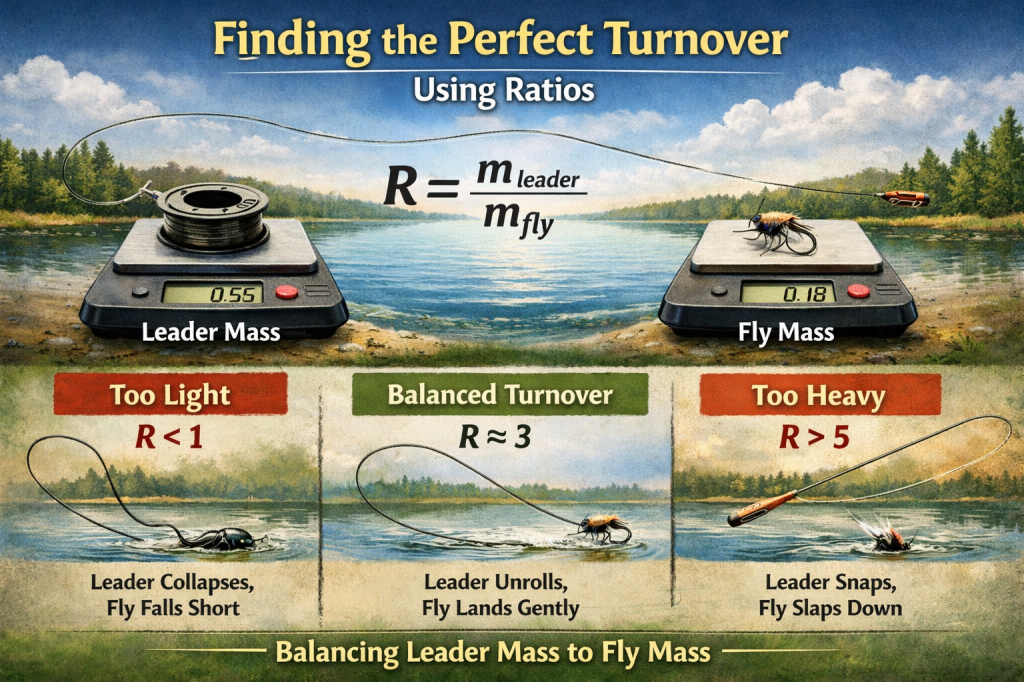
If you find yourself with good control over the fly, meaning the leader unrolls smoothly and the fly lands without kick or collapse, then you may have discovered the correct ratio of leader mass to fly mass for that particular fly and leader style.
In simple terms, this ratio is found by weighing the entire leader and the fly separately. Using the formula we can deduce the ratio:
R = M_leader / M_fly
Where:
M_leader = total mass of leader (grams)
M_fly = total mass of fly (grams)
When this ratio is balanced, the leader carries just enough mass to torn the fly over without overpowering it. The cast straightens, relaxes, and the fly settles onto the water naturally.
If the leader mass is too small relative to the fly, the system struggles to turn over and the leader may collapse or hinge. If the leader mass is too large, then the system can become too aggressive, snapping the fly forward and disturbing presentation.
The goal is not a universal number, but a repeatable relationship between the weight of the leader and the weight of the fly. Once you find a combination that produces a clean turnover, the ratio between those two masses becomes a useful reference when building or adjusting future leaders.
Though this describes the relationship between leader and the fly on a general basis, this doesn’t explain why a long leader can be put on a heavy rod to turn over a small fly, while a shorter leader can turn over the same fly on a lower weight rod.
Different rods deliver different amounts of power into the casting system. A heavier rod can accelerate more line mass and therefore has more authority to turn over a leader and fly. Because of this, the same leader and fly may behave differently on a 5-weight rod than on an 8-weight rod. To account for this, we can introduce a simple power constant:
P = W / W_ref
Where:
W = rod weight (for example, a 5wt is represented by a 5)
W_ref = Reference rod weight used for comparison.
For a freshwater system a convenient reference rod weight is:
W_ref = 12
For a saltwater system, a larger value such as 15 can be used.
Including this power constant adjusts the ratio to account for the rod delivering the cast:
R = P * (M_leader / M_fly)
However, mass alone doesn’t explain the turnover in a leader. The turnover in a leader is dependent on the stiffness of each section. Each section’s stiffness is dependent on the diameter of the material, and the material itself.
If you know the diameters of your leader sections, you can finally quantify the leader’s ability to turnover a fly in a way that’s measurable: how fast stiffness decays down the taper.
For a round leader, bending stiffness scales like d^4. You don’t need the full I=πd^4/64 unless you want absolute units. For comparing tapers, the relative stiffness index is enough:
S_i=d_i^4
Where d_i is the diameter of section i (in any consistent units: inches, mm — doesn’t matter). This gives you a number that explodes as diameter increases, which matches reality.
To find where the leader will hinge, compute the stiffness ratios between sections:
StepRatio_i = (S_i + 1) / S_i = ((d_i + 1)/d_i)^4
Interpretation:
- If StepRatio is close to 1 → smooth energy transfer (good taper step)
- If it’s tiny (like 0.1 or 0.01) → huge stiffness drop → hinge point (good for delicacy, bad for turnover in wind / heavy flies)
This is the real math behind “too thin too fast.”
You want one knob that says: Is this leader built for power or delicacy?
TaperIndex = Sum(L_i * d_i^4) / Sum(L_i)
Where:
L_i = length of section
d_i = diameter of section
That’s a length-weighted average stiffness.
- high TaperIndex → power leader
- low TaperIndex → delicate leader
Then we combine this with the mass ratio. This will produce a single “turnover authority” indicator.
Authority = P * (M_leader / M_fly) * TaperIndex
As long as you always compute TaperIndex using the same diameter units (all inches or all mm), it’s consistent within your system. You can compare leaders as long as you don’t switch units midstream. Downside: if you ever change units, the magnitude changes.
Authority can be described as energy in and TaperIndex is energy out, or after calculating, Authority can be described as energy out. This is kind of like Kirchhoff’s law of energy in is equal to energy out. The energy transfers down the leader and softens with each segment, or change in stiffness, and the fly’s drag. Only if in a windy environment will an alternate force come into play.
Fly casting is often described as an art, but the behavior of a leader in the air follows simple mechanical rules. The leader must carry enough mass to move the fly, the rod must provide enough power to drive the system, and the taper must transfer that energy smoothly from the butt of the leader down to the tippet.
By weighing the leader and the fly, anglers can establish a repeatable mass ratio that describes how much material is available to turn the fly over. By including a rod power constant, the model accounts for the fact that heavier rods can deliver more energy into the casting system. Finally, by examining the diameters of each leader section, anglers can quantify how stiffness changes along the taper and identify where the leader carries power and where it softens for delicacy.
Taken together, these measurements provide a simple framework for understanding turnover. Instead of guessing whether a leader will perform well, anglers can begin to see why one leader works while another fails. A system with too little leader mass may collapse before the fly straightens. A system with too much mass may snap the fly forward too aggressively. And a taper that drops diameter too quickly may introduce hinge points that interrupt the transfer of energy.
The goal is not to produce a universal number that works for every rod, fly, or fishing situation. Rather, the goal is to establish a consistent relationship between rod power, leader mass, fly mass, and taper geometry. Once an angler discovers a combination that produces smooth extension and gentle presentation, that configuration can be measured, recorded, and reproduced.
Over time, these ratios become a practical reference for building new leaders and adapting to different flies, conditions, and rods. In this way, leader design becomes less about trial and error and more about understanding the mechanics of the system.
 Mad Angler Hub
Leave a comment