ChatGPT Image
As fly anglers, we are often more concerned about our leader than any other part of our rod and reel system. The leader is the final delivery system when presenting the fly, so it is crucial that the geometric shape of the leader is proportionate and of the right stiffness. Otherwise, the angler will have knots, withering flies, or flies that slap the water, all of which can spook fish.
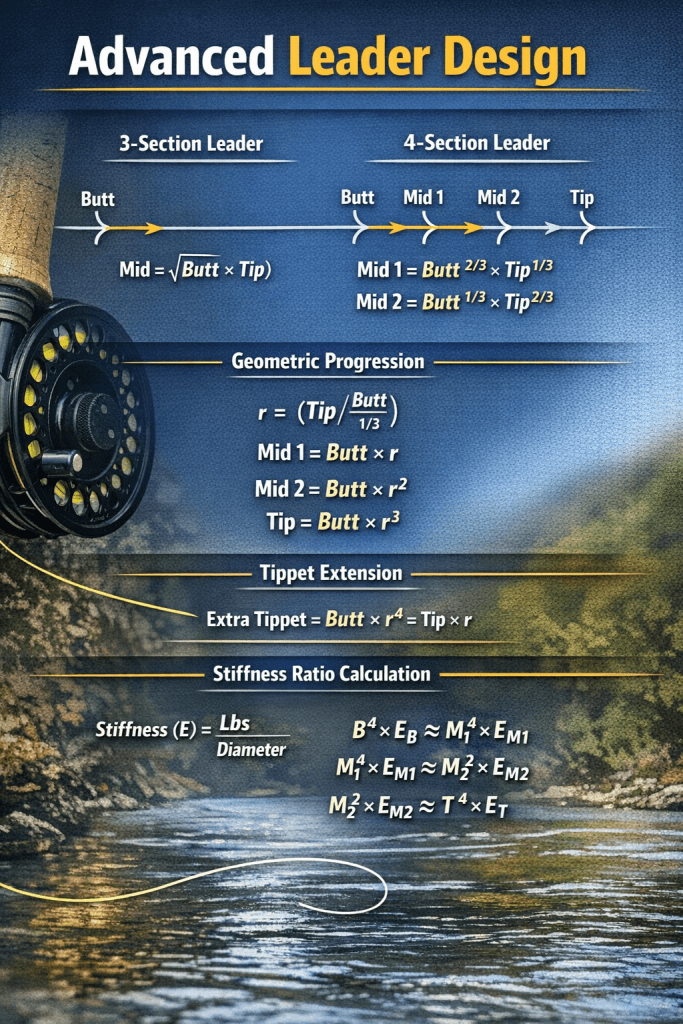
Calculating a leader mathematically before tying it is one way to guarantee the leader will perform critically. In my article Advanced Leader Design (https://madanglerhub.com/2026/01/30/advanced-leader-design/) I explain how to calculate the mid-section for a three section leader. If you know your tippet and butt then you can calculated the mid section and have a smooth transfer of energy based on a mid line between the butt and the tippet, as seen here:
3 section
mid = sqrt(butt * tip)
A four section can be calculated, but needs further break down of the formulation. Because each unknown depends on the other, the system becomes recursive and impractical to solve in the field.
4 section
mid_1 = sqrt(butt * mid_2)
mid_2 = sqrt(mid_1 * tip)
Therefore:
mid_1 = sqrt(butt * sqrt(mid_1 * tip))
This is unusable in the field so we solve for mid_1:
mid_1 = butt^2/3 * tip^1/3
mid_2 = butt^1/3 * tip^2/3
In a geometric progression, each term is found by multiplying the previous one by a fixed, non-zero number called the common ratio (r).
To find the values for a 4-section leader (Butt, Mid 1, Mid 2, and Tip), we have to bridge the gap between the Butt (B) and the Tip (T) in three equal proportional steps.
We have to fill three gaps:
- B->M_1 = r
- M_1->M_2 = r^2
- M_2->T = r^3
To find r we use the relationship T = B * r^3
r = 3_root(T/B)
Constant ratio form:
r = (tip/butt)^1/3
Substituted:
M_1 = B * (T/B)^1/3
M_2 = B * (T/B)^2/3
So:
mid_1 = butt * r
mid_2 = butt * r^2
tip = butt * r^3
Each section is the previous diameter times the same ratio. So, if you have a tapered leader, and you want to keep the same taper, rather than extending the tippet with the same diameter, then use:
extra_tippet = butt * r^4 = tip * r
This will place the fly on the water more delicately, as continuing the taper preserves the leader’s energy transfer characteristics. Adding straight tippet instead will soften the final turnover. This formula can also be used to repair tapered leaders. If the three section formula is used then a tapered leader can be repaired to a full taper using extra tippet material.
Tippet_repair = broken_tippet * r^section
If you are mixing brands of mono or transitioning to fluoro, the “smoothness” might hitch because fluoro is denser and stiffer. To truly perfect the repair formula, you might eventually want to account for the Stiffness (E) Ratio:
(D_1^4 * E_1) ≈ (D_2^4 * E_2)
In Advanced Leader Design I show how we can use a Material Constant as a stiffness ratio:
E = LBS / Diameter
This is not a true modulus, but it is a reasonable field proxy for stiffness differences between lines. For anglers this is perfectly acceptable as an empirical ratio. Just make clear that it is an approximation, not a material constant in the engineering sense.
To use this we simply create a chain going down the leader. For a three section leader:
(B^4 * E_B) ≈ (M_1^4 * E_M1)
(M_1^4 * E_M1) ≈ (M_2^4 * E_M2)
(M_2^4 * E_M_2) ≈ (T^4 * E_T)
 Mad Angler Hub
Leave a comment