ChatGPT Image
Spring is approaching. This morning’s temperature climbed to 53-degrees-Fahrenheit, the subtle signs are showing. With last week’s cloud cover, blast of cold air, snow, and rain, I don’t suspect the lakes’ temperature to be climbing rapidly. In winter and early spring, I wait for the water temperature to rise after long periods of sunlight. When the barometer starts to drop, then the fishing game is on.
I have a two-pole system to combat the spring wind. Here in Boise, we will get calm morning and evenings with the afternoon wind on full blast. One of the methods of rigging I use includes selecting a higher weight to cut bigger flies through the during the windy part of the day, and a lower weight to handle delicate flies when the day is calm. Other methods of rigging include having one rod rigged for the target fish with a standard fly, while the other is rigged as a counter to the main rig (a rod to target a different water column or river lane; or a rod to reach different cover). Sometimes I’ll rig the second rod to target a different fish altogether (a trout rod and a bass rod). This system keeps me in the field longer while boosting performance through rough environmental conditions.
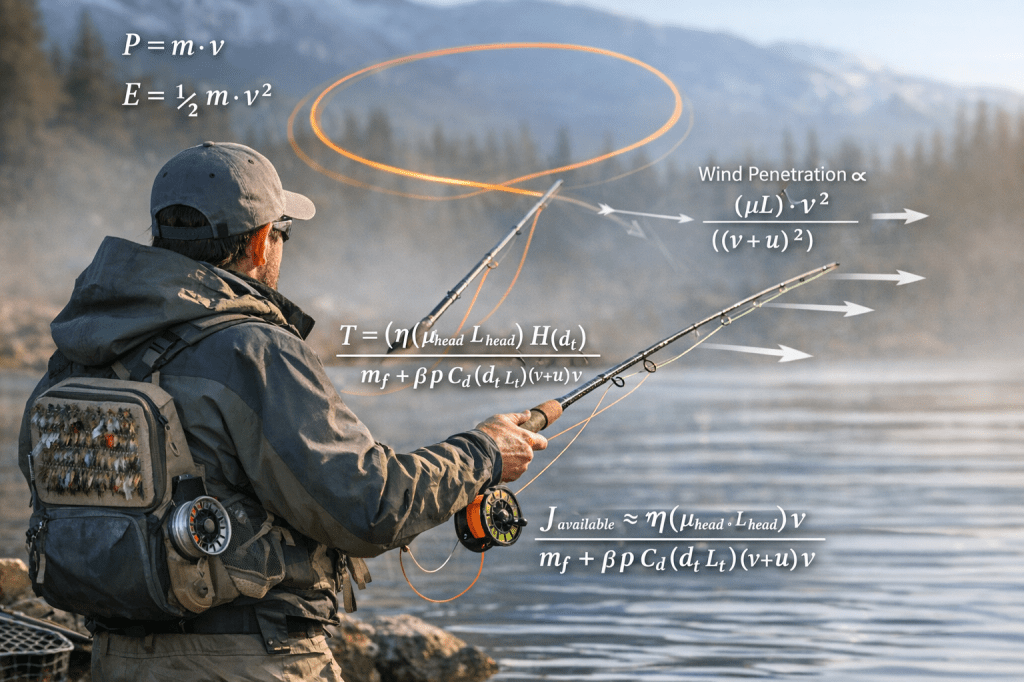
When you cast into the wind, the cast fails for one of two reasons: wind drag, or timing failed to maintain tension and loop shape at the speed required. So “cutting power” is basically: how much momentum/energy the loop carries forward per amount of drag it experiences. The two physics ingredients: drive, or the kinetic energy of the moving line, and resist, the aerodynamic drag from the wind.
In this physics model we will use Newton’s Law of linear momentum to describe the “punch” of the line through the air. Momentum index:
P = m ⋅ v
And we will use the Leibniz and Châtelet definition for kinetic energy to define the line in motion and how much it will “keep going”. Energy index:
E = 1/2 ⋅ m ⋅ v^2
Where:
m ≈ μ ⋅ L
m = mass of the line that’s actually moving in the loop (not the whole reel)
μ = mass per unit length (line weight)
L = length of line outside tip (or a consistent reference length like 30–40 ft)
v = average line speed during loop travel
To define wind resistance of the line we use:
A_line ≈ d_line ⋅ L_exp ⋅ k_shape + A_fly
and use the wind resistance term:
F_d ≈ ½ ⋅ ρ ⋅ C_d ⋅ A_line ⋅ v_rel^2
Where:
d_line = effective diameter of the part of the line in the loop (m)
L_exp = exposed length of line that’s actually in the wind as the loop propagates (m)
k_shape = “loop geometry factor” (dimensionless) to capture that a tight loop presents less area than a wide, floppy loop
A_fly = projected area of the fly/flies (m²). For a notebook model you can treat this as a “fly size class” constant.
headwind: v_rel ≈ v + u
tailwind: v_rel ≈ v – u
v = line speed (ft/s)
u = wind speed (ft/s)
ρ_air ≈ 1.1–1.3kg/m3
[]
Drag scales with wind density, area, and relative speed squared. So, wind resistance grows fast as wind and line speed stack together.
In a field ready model we need the “cutting power,” so we use:
Wind Penetration ∝ ((μL) ⋅ v^2) / ((v+u)^2)
That ratio is basically:
numerator = what you’re bringing to the fight
denominator = how hard the wind is punching back
Turnover is just a fight between three things:
the power of your cast,
the stiffness of your leader,
and the weight of your fly.
Meaning if the diameter of the leader from butt to tippet has the proper shape and backbone it will turn the fly over and gently place it on the water. We use simple a ratio formula:
Turnover Number T = J_available / J_required
Interpretation:
T≫1: hard turnover, kick, potential slap/jerk
T≈1: “perfect” turnover (straightens then relaxes into layover)
T≪1: fails to turn over (pile / hinge / leader collapse)
Your fly line delivers energy down the leader. A tight loop carries more of that energy forward. A sloppy loop wastes it. A turnover expression:
J_available ≈ η(𝜇_head * 𝐿_head)v
𝜇_head: mass/length of the portion of line actually driving the loop (head)
𝐿_head: effective driving length (often “some fraction of head outside tip”)
𝑣: loop speed
𝜂: efficiency factor (0–1) that quietly includes timing, loop tightness, tracking, etc.
Bad timing/wide loop = low 𝜂
Crisp loop = high 𝜂
To accelerate and to straighten terminal rig:
J_required≈fly_inertia{mfv} + tippet_drag_term{β ρ C_d(d_t L_t) (v+u) v}
Hinge transmission through the diameter of the tippet:
Bending stiffness for a circular section uses area moment of inertia:
I=(πd_t^4) / 64
The leader is a taper. It’s designed to transfer that energy step by step—from thick to thin. But the tippet is the weakest link. If it’s too thin, it acts like a hinge and the energy dies there.
So, make a dimensionless “hinge factor”:
H(d_t) = (d_t / d_ref)^4
This says: go a little thinner and turnover authority collapses fast. The fly is mass at the end of the system. The heavier it is, the more it resists being turned over. A perfect cast happens when those three things balance.
Put it together: a practical turnover number
T = (η (μ_head L_head) v H(d_t)) / ( m_f v + β ρ C_d (d_t L_t) (v+u) v)
T = (η (μ_head L_head) H(d_t)) / ( m_f + β ρ C_d (d_t L_t) (v+u) )
Or a simpler version useful for intuition:
T_simple = (η (μ_head L_head)) / m_f ) * ((d_t / d_ref)^4)
Snapshot:
If the leader never fully straightens → you’re underpowered (or too thin/light)
If it snaps straight and recoils → you’re overpowered (or fly too heavy)
If it unrolls and just barely kisses straight → you nailed it
The golden rule:
Watch your leader, not your fly.
This model is useful for anglers who want precision. For the ones willing to measure—
to weigh their flies, match their lines, and even put calipers on their leader material. It’s for anglers who don’t want to guess.
Because when you understand the system, you stop forcing the cast.
You’re no longer trying to overpower the wind, or muscle the fly into place.
You’re matching the energy of the cast to the structure of the leader and the mass of the fly.
And when that balance is right… something strange happens. The cast gets easier. Not harder—easier. Less effort, tighter loops, cleaner turnover. The system starts working for you instead of against you.
 Mad Angler Hub
Leave a comment